12 Examples of AI Writing I Annotated Line by Line From Real Client Drafts
What Do Real Examples of AI Writing Look Like?
A real example of AI writing is a full passage, not one flagged word sitting by itself.
Most guides built around ai written text examples teach you to spot “leverage” or “delve” on sight. That’s the easy part, and it’s also the smallest part of the problem.
The harder part is a paragraph where four separate tells sit on top of each other. A cliché opener, a hedge word, a buzzword, and a sentence rhythm that never changes pace.
None of those four is damning alone. Stacked in the same three sentences, they read like nobody specific wrote them.
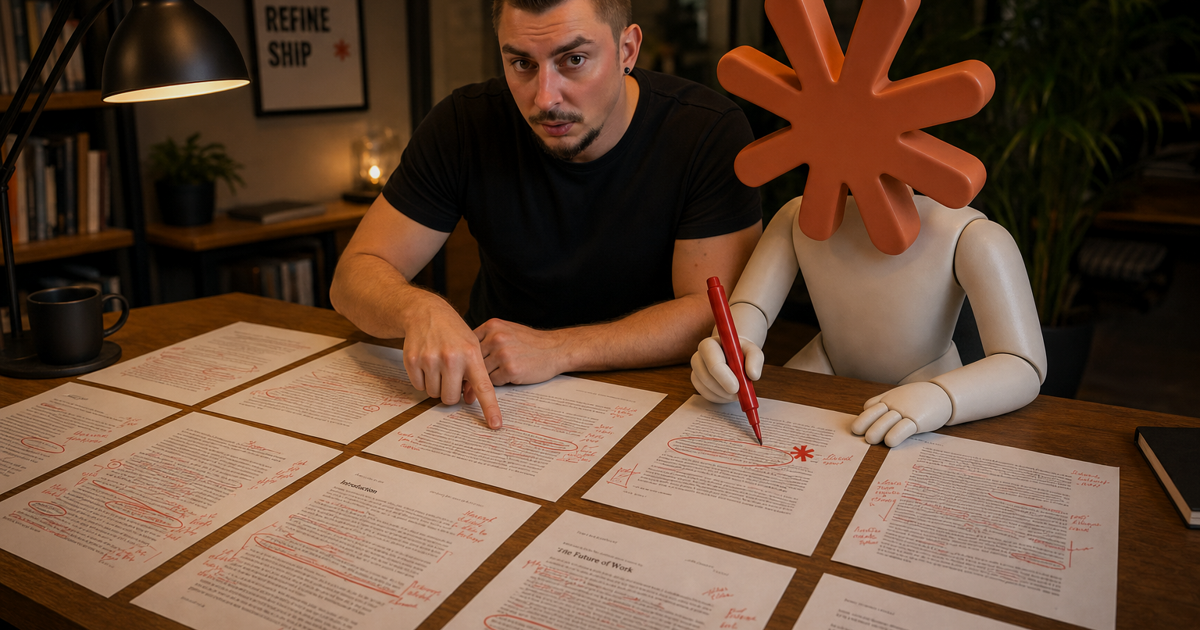
So instead of one flagged sentence, I pulled twelve full passages from drafts I’ve edited myself, marked up the way I’d mark them for a client.
Each one gets the flagged version, what’s happening in it, and the rewrite I sent back.
Every name, company, and identifying detail below has been changed. The sentences and the fixes are real.
What Does AI Writing Look Like in Outbound Copy?
Outbound copy fails fastest, because a stranger reads the first line and decides in about two seconds whether a person wrote it.
The Cold Email Example
Flagged, from a cold email to a mid-size ecommerce brand: “In this fast-paced digital landscape, businesses need to leverage every advantage to stay ahead of the competition. Additionally, our team’s robust approach can help you navigate these challenges effectively.”
What’s happening line by line:
-
Sentence one opens with the fast-paced-landscape cliché, a phrase that fits any industry because it names none of them.
-
“Leverage” and “robust” are graveyard words doing the work a real claim should be doing. - “Additionally” is a transition crutch holding two vague sentences together instead of one sentence that says something.
What I sent back: “You’re running Black Friday ads on a site that takes 4.2 seconds to load on mobile. That’s costing you roughly one in four buyers before they see the offer.”
Same open, but now there’s a number the prospect can check themselves.
The LinkedIn Post Example
Flagged, from a founder’s LinkedIn draft: “Hot take: most agencies overpromise and underdeliver. The result? Burned budgets and broken trust. Bottom line—we do things differently.”
What’s happening line by line:
-
“Hot take” and “The result?” are forced sass openers, the kind that perform confidence instead of earning it.
-
The double dash before “we do things differently” welds two ideas together instead of finishing the first one. - Three short claims in a row, no specific agency, no specific number, nothing this founder could only say about their own business.
What I sent back: “I fired an agency in March for billing 40 hours on a landing page that took me a weekend to rebuild myself. That’s the whole reason I started this company.”
One sentence, one number, one thing that could only have happened to this specific person.
The Cold LinkedIn Connection Message Example
Flagged, from a connection request template: “I noticed your company serves as a leader in the industry. Selling isn’t the point here. Building genuine relationships that drive long-term value is.”
What’s happening line by line:
-
“Serves as” avoids the plain word “is,” a small swap a model makes constantly and a person almost never does.
-
The second and third sentences negate a claim nobody made, then reassert a fancier-sounding version of it. - Neither sentence names what the company sells.
What I sent back: “I saw you’re hiring three account managers this quarter. That usually means your onboarding docs are about to get read by people who didn’t write them, which is exactly the kind of copy I fix.”
That’s specific enough that it could only be sent to this one company.
What Does AI Writing Look Like on a Website?
A website has more room to hide the tells, since most visitors skim instead of reading it out loud, and that’s exactly why the tells survive there longest.
The Landing Page Hero Example
Flagged, from a SaaS landing page hero: “Unlock a revolutionary, state-of-the-art platform that empowers your team to elevate performance and achieve seamless results, every single time.”
What’s happening line by line:
-
Five graveyard words stacked into one sentence: unlock, revolutionary, state-of-the-art, empowers, elevate, seamless.
-
No noun in the sentence names the actual product. - The rhythm is one long clause piling adjective on adjective, with nowhere for a reader’s eye to land.
What I sent back: “Your support team answers the same 12 questions every week. This platform answers them for you, in your product’s voice, before a ticket gets opened.”
Two short sentences, one real number, and a reader can picture what the product does before they finish reading.
The Founder Bio Example
Flagged, from a coaching site’s founder bio: “The founder built this company after recognizing a gap in the market. This pivotal moment shaped a mission to empower entrepreneurs everywhere.”
What’s happening line by line:
-
Third person throughout, never “I,” even though a bio is the one page built for first person.
-
“Pivotal moment” inflates an ordinary decision into something bigger than it was. - “Empower entrepreneurs everywhere” promises a scope nobody running one coaching business can deliver.
What I sent back: “I quit my agency job after a client paid me $8,000 for a funnel that made them $40 in three months. I built this company to make sure that never happens to anyone else who hires me.”
The first version could be any founder of any coaching business. The second one could only be this person.
The About Page Example
Flagged, from an agency’s About page: “We bring a holistic approach to a diverse tapestry of client needs, underscoring our commitment to your growth.”
What’s happening line by line:
-
“Holistic,” “tapestry,” and “underscoring” are three graveyard words in one 16-word sentence.
-
The sentence claims a commitment without naming a single thing the agency does to earn it. - The sentence would still read fine if you swapped in a different agency’s name.
What I sent back: “We handle your ads, your email flows, and your landing pages, so you’re not managing three freelancers who never talk to each other.”
Three named services replace one vague phrase, and the reader knows exactly what they’re buying.
Want this done for you? Book a free strategy call →
What Does AI Writing Look Like in Client Communication?
Client-facing writing is where I catch the most tells, since these drafts move fast and most never get read out loud before they’re sent.
The Product Update Email Example
Flagged, from a SaaS product update email: “This update could potentially improve load times for some users, depending on their configuration; however, results may vary, and we generally recommend testing thoroughly.”
What’s happening line by line:
-
“Could potentially,” “for some users,” and “may vary” are three hedges in one sentence, none of them committing to anything.
-
The semicolon plus “however” does the job a full stop and a real claim should be doing. - A customer reading this has no idea whether the update will help them.
What I sent back: “This update cuts dashboard load time from 4 seconds to under 1. You’ll notice it the first time you open the app after updating.”
One committed claim, one number, one thing the customer can go check for themselves.
The Case Study Draft Example
Flagged, from a B2B case study draft: “The client had a leaky funnel. Email open rates were declining. Landing pages weren’t converting. Studies show that most B2B buyers abandon a purchase after one bad email.”
What’s happening line by line:
-
Four flat, same-length sentences in a row with nothing connecting one to the next.
-
That statistic has no source, because I checked and no study said that. - The passage lists three problems without explaining how any of them relate to each other.
What I sent back: “The client’s funnel was leaking everywhere at once. Open rates were sliding while landing pages weren’t converting, so we fixed both at the same time.”
Two connected sentences instead of four disconnected ones, and no invented statistic doing the persuading. I’ve written a full pass on catching fabricated numbers like that one in how to fact-check AI content.
The Testimonial Request Email Example
Flagged, from a testimonial request template: “Your feedback would mean the world to us. Hot take: testimonials are the game-changing, seamless way to build trust with future clients.”
What’s happening line by line:
-
“Would mean the world to us” is a stock phrase that could open any request email for any business.
-
“Hot take” shows up again, the same forced sass opener from the LinkedIn example, this time on a completely different type of draft. - “Game-changing” and “seamless” sound confident about nothing specific.
What I sent back: “Would you be up for a two-line quote about the redesign? Even ‘it works and support responds fast’ is more useful to me than a paragraph.”
Shorter, and it tells the client exactly what kind of answer would help.
What Does AI Writing Look Like in Content Marketing?
Content marketing is where the cliché openers live longest, because a blog post has to start somewhere, and the fast-paced-landscape cliché is sitting there waiting.
The Blog Intro Paragraph Example
Flagged, from a marketing blog draft: “In this ever-evolving digital landscape, businesses must constantly adapt to stay relevant. This comprehensive guide will dig deep into the strategies you need to navigate this dynamic environment.”
What’s happening line by line:
-
“Ever-evolving digital landscape” and “dynamic environment” are two versions of the same cliché in two sentences.
-
“Dig deep” and “navigate” are graveyard words carrying zero information about what the guide covers. - Neither sentence names a single specific strategy, tool, or number.
What I sent back: “I’ve rebuilt 40+ email sequences for clients switching platforms, and the same three mistakes show up almost every time. Here’s what they are and how to skip them.”
A real count and a specific promise replace two sentences that said nothing.
The Newsletter Recap Example
Flagged, from a nonprofit’s monthly newsletter: “Our volunteers work hard every day. They serve meals to families in need. This impact ripples through the community. Every donation makes a real difference.”
What’s happening line by line:
-
Four sentences, all close to the same length, each one a flat statement with no connector to the one before it.
-
Not one sentence names a person, a place, or a number. - The closing line is the kind of tidy wrap-up that shows up whether the paragraph earned it or not.
What I sent back: “Rosa’s worked the serving line every Tuesday for six years. Last month alone she fed 340 families, and that number only happens because someone kept showing up.”
One named person, one real number, and sentences that build on each other instead of sitting side by side.
The Workshop Sales Page Example
Flagged, from a workshop landing page: “This workshop will unlock your potential, empower your team, and elevate your entire content strategy. This isn’t a course. Call it a transformation instead.”
What’s happening line by line:
-
Three verbs in a row (unlock, empower, elevate) forcing a rule of three where the real list might only have one honest item.
-
The closing line negates “a course” to reassert “a transformation,” the same move flagged in the cold connection message above, dressed for a different format. - Nothing in the sentence tells a buyer what they’ll walk away with.
What I sent back: “You’ll leave with a content calendar for the next 90 days, already written. That’s it. That’s the workshop.”
Real thinking rarely produces a clean three. Sometimes there’s one thing that matters and the rest is padding.
12 Examples of AI Writing at a Glance
| # | Context | Tells stacked | What changed in the rewrite |
|---|---|---|---|
| 1 | Cold email | Cliché opener, graveyard words, transition crutch | Added a specific site-speed number |
| 2 | LinkedIn post | Forced sass, welded clause, empty triple | Added one real, specific story |
| 3 | Cold connection message | ”Serves as” avoidance, negate-then-reassert | Named the prospect’s actual hiring signal |
| 4 | Landing page hero | Five graveyard words in one sentence | Named the product’s function and a number |
| 5 | Founder bio | Third person, inflated “pivotal moment” | Switched to first person with a real dollar figure |
| 6 | About page | Three graveyard words in 16 words | Replaced with three named services |
| 7 | Product update email | Triple hedge, semicolon-plus-however | Committed to one measurable claim |
| 8 | Case study draft | Sentence stacking, fabricated statistic | Connected the facts, cut the fake number |
| 9 | Testimonial request | Stock phrase, forced sass, graveyard words | Asked for a specific two-line quote |
| 10 | Blog intro | Cliché landscape opener, graveyard words | Opened with a real count and a promise |
| 11 | Newsletter recap | Flat sentence stacking, no named person | Named a real person and a real number |
| 12 | Workshop sales page | Forced triple, negate-then-reassert | Cut to one honest deliverable |
What Are Some Signs That a Text Is Written by AI?
The fastest tell is a paragraph where every sentence runs the same length with nothing connecting one to the next, the sentence-stacking pattern in Examples 8 and 11 above.
I broke that pattern into fourteen separate signs, organized by word choice, sentence rhythm, and structure, in the full list of signs of AI writing.
What Are AI Words to Avoid?
Delve, leverage, tapestry, robust, seamless, elevate, unlock, navigate, and landscape top the list, and eight of the twelve passages above use at least one of them.
I keep the running graveyard, with what to say instead of each word, in the AI words to avoid post.
What Words Give Away ChatGPT?
Forced sass openers give it away fastest. “Hot take,” “The result?,” and “Bottom line” showed up in three separate examples above, across three completely different formats.
They read as personality the first time you see one. By the third one in the same inbox, the pattern is obvious.
I tested 13 AI detectors against known writing samples, and even the best ones catch this tell less reliably than a person reading the paragraph out loud.
How Many AI Tells Usually Show Up in One Passage?
Two or three, based on the twelve passages above, with the landing page hero in Example 4 stacking five graveyard words into one sentence alone.
One tell by itself could be a tired human writer having an off day. Three or four in the same few sentences is what makes a passage read like nobody specific wrote it.
I go deeper on why that stacking effect matters more than any single word in how to make AI writing sound human, and I’ve catalogued the recurring shapes behind it in this breakdown of AI writing tropes.
What Do These Examples Cost You If You Miss Them?
A reader scanning any of these twelve flagged passages isn’t grading grammar. They’re deciding, in the first few seconds, whether a specific person who knows the business wrote it.
I watched a similar moment happen with a different client this year. A prospect emailed back one line, “this reads like a template,” before a formal quote had even gone out, and my client asked me to rewrite the whole page that same week.
Nothing on that page was factually wrong. It carried enough of these tells stacked together that a stranger caught it in ten seconds, without knowing a single term from this list.
That’s what these twelve examples are really about, more than the vocabulary or the grammar. It comes down to whether the next reader believes a specific person wrote the page for them.
I run this same line-by-line check, plus a broader 25-point editing pass, against every draft that lands in my inbox before it ships to a client.
If you want to run it yourself first, the free copy cleaner checks a draft against most of these same tells in one pass.
FAQ
What are some signs that a text is written by AI?
The fastest tell is flat, same-length sentences with nothing connecting them, sitting next to vague words like delve, leverage, and seamless. I break down all fourteen signs, with more single-sentence examples, in the full signs of AI writing list.
Can you give me some examples of AI words?
Delve, leverage, tapestry, robust, seamless, elevate, unlock, navigate, and landscape are the words I flag most in client drafts, and I keep the running list in the AI words to avoid post. On their own they're invisible. Three or four in the same paragraph is the tell.
What are AI words to avoid?
Swapping one flagged word for a synonym doesn't fix a passage, because the tell is density and rhythm, not one banned word. The twelve examples above show what that looks like once three or four tells stack in the same few sentences.
What words give away ChatGPT?
Forced sass openers like 'Hot take' and 'The result?' give it away faster than any vocabulary list, because they read as personality until you notice the same phrases in every draft. I tested 13 AI detectors against known samples, and most of them miss this exact tell too.
What does AI writing look like at the passage level?
It looks like three or four tells stacked in the same few sentences: a cliché opener, a hedge word, a buzzword, and a sentence rhythm that never varies. Any one of those alone could be a tired human writer. All four together is what the twelve examples above show.
Are these examples from real client drafts?
Yes, pulled from drafts I've edited, with every name, company, and identifying detail changed or removed. The passages and the fixes are real. The people attached to them aren't identifiable.
How many AI tells usually show up in one passage?
Two or three is the average across the twelve passages above, and the landing page hero example stacked five graveyard words into a single sentence. One tell alone is rarely enough to flag a passage on sight.
How do I check my own draft for these tells?
Read it out loud first, since that catches the rhythm problem faster than any checklist. Then run it against the free copy cleaner, which checks a draft for the same stacking pattern in one pass.
Want this built for your business? Book a free strategy call →